
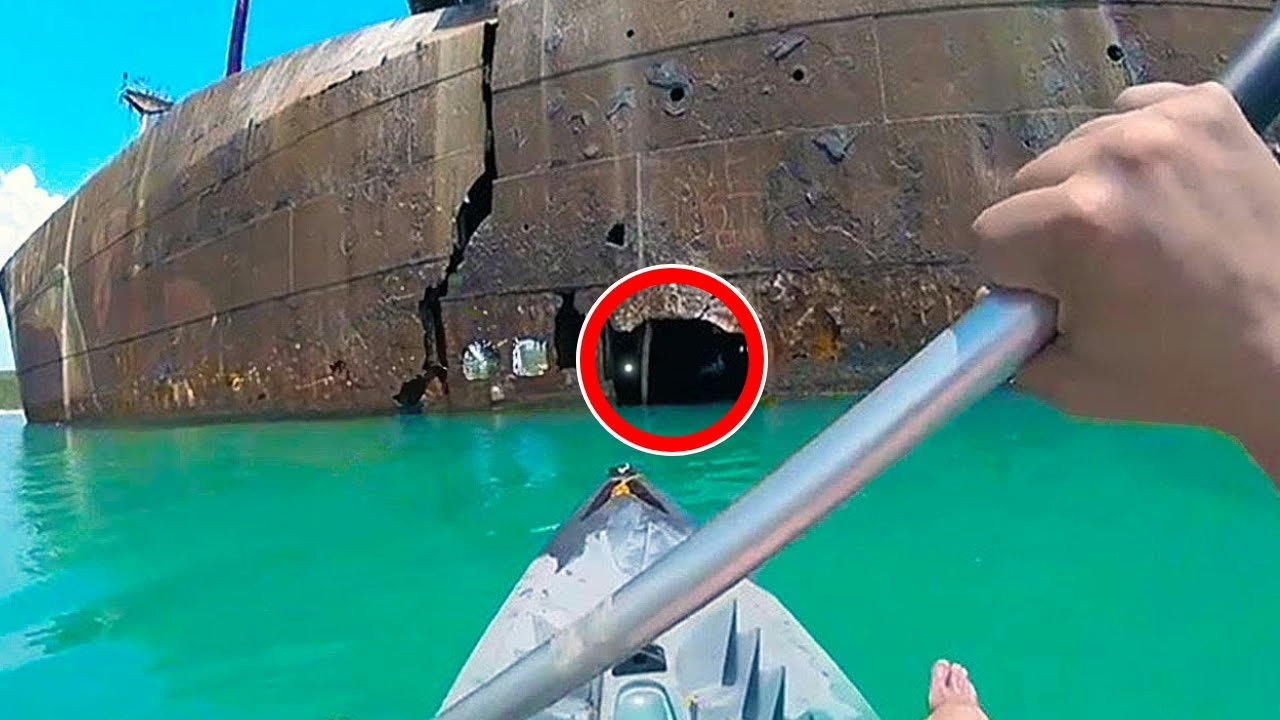
On a gray, rain-soaked Tuesday morning in Galveston Bay, Texas, the remnants of the USS Selma sat exactly as they had for decades, silent, massive, and largely ignored.
The concrete shipwreck, abandoned since 1922, has long been considered an eyesore rather than a historical site. Local fishermen steer clear of it. Tour boats keep their distance. Even seasoned divers rarely approach its jagged concrete hull, which rises from the water like the rib cage of some ancient sea creature.
Yet on that particular morning, something about the wreck was different.
Grace Benson, a 34-year-old kayaker and urban explorer, says she noticed something that stopped her cold. From deep inside the skeletal remains of the USS Selma, she claims she saw a warm orange light glowing steadily.
Not a reflection. Not a flash. Not lightning.
A sustained glow.
“I froze,” Benson said later. “I remember thinking, That shouldn’t be there.”
What followed would trigger an official investigation, spark online speculation across the country, and leave experts quietly admitting they had no clear explanation.
More than a year later, the mystery remains unsolved.
A Shipwreck Most People Avoid
The USS Selma is not a typical shipwreck.
Built during World War I as part of an experimental program, it was one of only a handful of concrete ships ever constructed by the U.S. Navy. The idea was simple: steel was scarce, concrete was cheap. In practice, the design proved flawed.
After only a few years of service, the Selma ran aground in Galveston Bay and was eventually abandoned. Over time, storms battered the vessel, its hull cracked, and large sections collapsed inward. Saltwater, algae, barnacles, and sediment invaded every exposed surface.
Today, experts agree on one thing: no interior space should remain intact.
“Concrete degrades differently than steel,” explained one maritime engineer familiar with the wreck. “Once seawater gets in, you expect widespread erosion, collapse, and biological growth. Especially after a century.”
That assumption is central to why Benson’s account raised eyebrows.
An Unlikely Explorer
Grace Benson is not a thrill-seeking influencer or content creator chasing viral moments. Friends describe her as methodical, cautious, and deeply respectful of abandoned sites.
She works a full-time job and spends her weekends kayaking, photographing derelict structures, and documenting shipwrecks for personal research. She keeps detailed notes, weather records, and location logs. She avoids dangerous entry points and never exaggerates her findings.
“She’s the least dramatic person I know,” said a close friend. “If she says something didn’t make sense, it probably didn’t.”
On that morning, Benson set out alone, paddling her vividly orange kayak through light rain toward the Selma. Thunder rumbled in the distance. The water was choppy but manageable.
As she approached the wreck, she noticed the atmosphere seemed to change.
“It felt quieter,” she said. “Not peaceful quiet. More like everything was holding its breath.”
“I Saw a Light Where No Light Should Exist”
Benson was navigating between two broken slabs of concrete when she noticed it.
A faint orange glow.
At first, she assumed it was a reflection. Rainwater sometimes pools inside the wreck, and sunlight can bend strangely through wet surfaces. But the sky was overcast. There was no sun.
She stopped paddling.
The glow remained.
“It wasn’t bright,” she said. “But it was warm. Steady. Like a lantern.”
Benson edged closer, heart racing. As she moved, the light did not shift or disappear. It grew clearer.
The source appeared to be coming from inside the hull, from a narrow opening barely large enough for a person to crawl through.
“There’s no electricity out there,” she said. “No boats anchored nearby. No reason for any light to be inside that wreck.”
Still, curiosity pulled her forward.
A Room That Shouldn’t Exist
Peering through the opening, Benson saw something she still struggles to explain.
Inside the wreck was a small chamber, enclosed on all sides, with straight walls and a relatively intact ceiling. Unlike the surrounding compartments, which were collapsed and filled with debris, this room appeared strangely preserved.
Even more unsettling, the space was illuminated.
Resting on top of a rotted wooden crate was what Benson described as an old-fashioned brass lantern, its glass panels glowing with a steady flame.
“It looked like something you’d see in a museum,” she said. “Not modern. Not improvised.”
Lanterns, of course, require fuel. Oxygen. Maintenance. And someone to light them.
“There was no smoke. No movement. No sound,” Benson said. “Just the glow.”
She called out.
“Hello?”
Nothing answered.
Leaving the Wreck
Fear finally overtook curiosity.
Benson backed away slowly, keeping her eyes on the opening. She felt an overwhelming sense of being watched, though she never saw another person.
“I didn’t want to stay long enough to find out I was wrong,” she said.
As she paddled away, the storm intensified. The water felt heavier, more resistant. She later described the trip back to shore as “the longest kayak ride of my life.”
Once on land, her hands were shaking.
She reported the incident to local authorities that same day.
Initial Skepticism
At first, officials were unconvinced.
A light in a shipwreck abandoned for a century sounded implausible at best. Investigators suggested she may have mistaken reflected lightning, bioluminescence, or even her own headlamp.
But Benson provided detailed descriptions: the location of the opening, the shape of the chamber, the position of the crate, and the style of lantern.
She also had GPS data from her kayak.
That level of specificity gave authorities pause.
Within hours, the Coast Guard and maritime historians agreed to conduct a site visit.
The Follow-Up Investigation
The next day, a small team returned to the USS Selma with Benson.
The weather had cleared. Visibility was excellent.
Using her directions, they located the opening almost immediately.
Inside, they found the chamber.
But the lantern was no longer lit.
In fact, no light source of any kind was present.
“There was no fuel residue, no soot, no scorch marks,” one investigator later noted. “Nothing indicating recent combustion.”
Even more puzzling was the room itself.
Compared to adjacent compartments, the chamber was unusually clean. There was minimal algae growth. The walls were intact. The ceiling showed no major fractures.
“It doesn’t line up with expected degradation patterns,” a maritime historian admitted.
A Growing Mystery
Word spread quickly.
By that evening, locals were whispering about “the light in the Selma.” Online forums lit up with speculation. Some claimed the wreck had always been strange. Others dismissed the story as exaggeration.
Within days, amateur divers, historians, and explorers arrived hoping to see the phenomenon for themselves.
None did.
The lantern never appeared again.
Theories and Speculation
As the investigation stalled, theories emerged.
Some suggested a transient chemical reaction caused a brief glow. Others proposed that a passing boat’s light had somehow refracted through the hull in a rare alignment.
A few claimed it had to be human, someone secretly using the wreck as shelter.
But authorities found no evidence of habitation. No food wrappers. No footprints. No fresh damage.
“There’s no logical reason for anyone to be living inside that wreck,” said one Coast Guard official. “It’s unstable and dangerous.”
Others whispered about something less conventional.
Benson refused to speculate.
“I’m not saying what it was,” she said. “I’m saying what I saw.”
The Official Conclusion
After several weeks, officials released a brief statement.
No artificial or natural light source was identified.
The chamber’s condition remains unexplained.
The reported phenomenon could not be replicated.
The case was closed.
No further study was scheduled.
Public Reaction
The decision frustrated some observers.
“How do you just shrug and walk away?” one online commenter wrote. “Either she imagined it, or something happened.”
Others praised the authorities for avoiding sensationalism.
Still, interest in the USS Selma surged.
Tourists visited the shoreline to photograph the wreck. Local businesses sold novelty merchandise. YouTubers uploaded speculation-filled videos.
The wreck, once ignored, became a minor legend.
Grace Benson’s Silence
Through it all, Benson remained quiet.
She declined interviews beyond factual recounting. She never monetized the story. She never altered her account.
“I don’t need people to believe me,” she said. “I just know what I experienced.”
Nearly a year later, she returned to the wreck alone.
The water was calm. The sky clear.
The chamber was unchanged.
And for a brief moment, she thought she felt warmth.
But when she blinked, there was nothing.
An Unanswered Question
Today, the USS Selma still sits in Galveston Bay, silent and hollow.
No one has explained the light.
No one has disproven Benson’s account.
And no one has seen the lantern again.
Whether it was a rare natural phenomenon, a momentary illusion, or something still unexplained, one fact remains:
A woman reported seeing something impossible, and science has yet to provide an answer.
Sometimes, the ocean keeps its secrets.
And sometimes, it lets someone glimpse one, just once.