
We often think of ancient civilizations as primitive—people struggling with basic tools, limited knowledge, and simple engineering. Yet scattered across the world are ancient structures and inventions so advanced that even modern scientists struggle to explain how they were created. These technologies challenge everything we assume about human progress and raise a haunting question: Were ancient people far more advanced than we give them credit for?
The Perfect Stonework of Machu Picchu
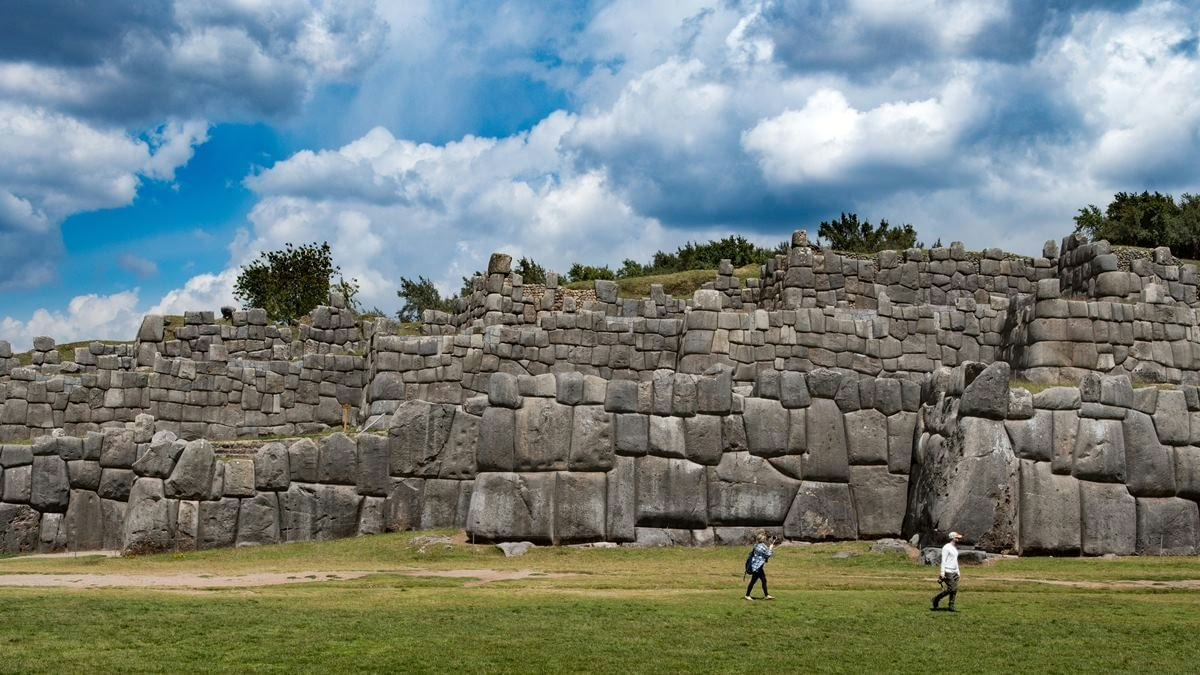
High in the Andes Mountains, Machu Picchu stands as a masterpiece of precision engineering. Massive stones fit together so tightly that even a blade of grass cannot slide between them. No mortar was used, and yet the structures have survived centuries of earthquakes.
What puzzles researchers is not just the precision, but the logistics. The stones weigh several tons, yet there is no evidence of wheels, iron tools, or draft animals capable of transporting them uphill. Even today, replicating this level of stone fitting would require advanced machinery and laser-guided cutting tools.
The Antikythera Mechanism: An Ancient Computer
Discovered in a shipwreck off the coast of Greece, the Antikythera Mechanism is often described as the world’s first analog computer. Dating back over 2,000 years, it contains a complex system of bronze gears designed to predict astronomical events such as eclipses and planetary movements.
The sophistication of the mechanism stunned scientists. Gear systems of this complexity were not thought to exist until at least a thousand years later. How ancient Greek engineers developed such advanced mechanical knowledge—and why it disappeared—is still a mystery.
The Unbreakable Roman Concrete
Roman buildings have stood for nearly two millennia, while modern concrete often crumbles after just a few decades. Structures like the Pantheon and Roman harbors remain intact despite earthquakes, storms, and the passage of time.
Modern analysis reveals that Roman concrete used a unique blend of volcanic ash and lime, creating a self-healing material that strengthens when exposed to seawater. Despite understanding the ingredients, scientists still struggle to fully replicate the durability of this ancient formula at scale.
The Precision of the Egyptian Pyramids
The Great Pyramid of Giza is aligned with the cardinal directions with astonishing accuracy—off by only a fraction of a degree. Its massive limestone blocks weigh up to 80 tons, yet they were placed with millimeter-level precision.
No surviving records explain exactly how the pyramids were built. Theories range from ramps to lost construction techniques, but none fully explain how ancient Egyptians achieved such precision without modern surveying tools, cranes, or power machinery.
The Nazca Lines: Messages for the Sky?
In the deserts of Peru, the Nazca Lines stretch across miles of arid land, forming giant geometric shapes and animal figures. The designs are so large that they can only be fully appreciated from the air.
How did the Nazca people create such precise patterns without aerial views? And why? Theories include religious rituals, astronomical calendars, and water mapping, but no explanation fully accounts for their scale and accuracy.
Baghdad Battery: Ancient Electricity?
In the 1930s, archaeologists uncovered a curious object near Baghdad: a clay jar containing a copper cylinder and an iron rod. When filled with an acidic liquid, it produces a small electric charge.
Known as the Baghdad Battery, this artifact dates back nearly 2,000 years. Some believe it was used for electroplating metals, while others argue it had a ritual or medical purpose. No definitive explanation exists, leaving open the possibility that ancient people experimented with electricity long before it was “discovered.”
The Mysterious Vibrating Statues of Egypt
Ancient records describe Egyptian statues that appeared to emit sounds at sunrise, most famously the Colossi of Memnon. Travelers claimed the statues sang or hummed when warmed by the morning sun.
Modern theories suggest temperature changes caused air movement within cracks, producing sound. But ancient texts imply deliberate design, hinting at acoustic engineering far ahead of its time.
Knowledge Lost to Time
One of the most unsettling aspects of ancient technology is that much of it seems to have vanished. Wars, natural disasters, and the collapse of civilizations destroyed libraries, workshops, and the skilled knowledge passed down through generations.
The Library of Alexandria alone is believed to have housed countless scientific works that could have changed the course of human development. What technologies might we still possess today if that knowledge had survived?
Rethinking the Ancient World
Ancient technologies we can’t explain don’t mean ancient people had modern machines—but they do suggest they possessed a deep understanding of mathematics, astronomy, materials, and engineering. Their achievements weren’t accidents; they were the result of sophisticated thinking and innovation.
These mysteries force us to rethink history—not as a straight line of progress, but as a series of peaks and losses. Perhaps the greatest secret of ancient technology is this: human brilliance has always existed—we just keep forgetting it.