
History is full of catastrophic accidents, many of which were not caused by natural disasters or complex systems failing, but by simple human errors. A missed calculation, a misread instruction, or a lapse in judgment can sometimes trigger disasters of unimaginable scale. These accidents remind us that even small mistakes can have enormous consequences, affecting thousands of lives and shaping history. From industrial mishaps to transportation blunders, the deadliest accidents caused by simple errors are both shocking and sobering.
The Chernobyl Disaster: A Button Pressed Too Soon
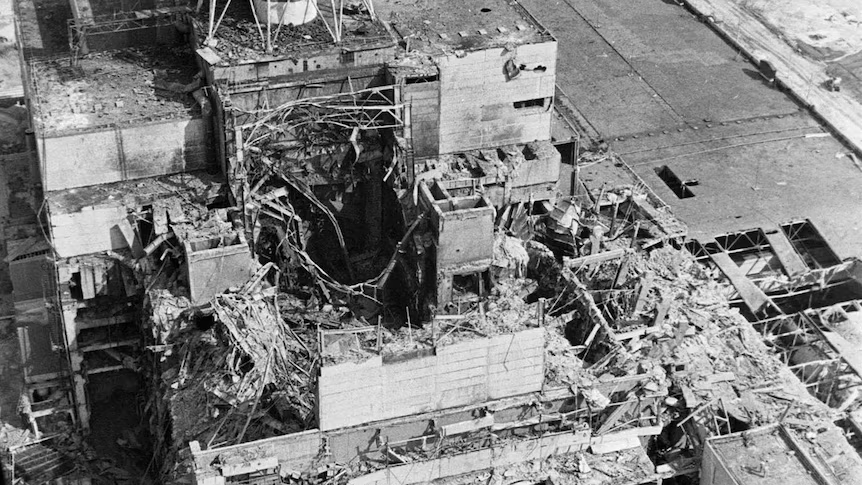
On April 26, 1986, the Chernobyl nuclear power plant in Ukraine experienced the worst nuclear accident in history. While complex factors contributed, a crucial part of the disaster was human error during a safety test.
Operators disabled key safety systems and pressed the wrong buttons at critical moments. This caused a massive reactor explosion, releasing radioactive material across Europe. Over 30 people died immediately, while thousands more suffered long-term radiation effects. What made Chernobyl particularly tragic was that it could have been prevented with proper procedures, highlighting how small errors in high-stakes environments can be catastrophic.
The Tacoma Narrows Bridge Collapse: Ignoring Physics
In 1940, the Tacoma Narrows Bridge in Washington, USA, earned the nickname “Galloping Gertie” because it wobbled dramatically in strong winds. Engineers had underestimated the effects of wind-induced vibrations—a simple miscalculation in aerodynamics.
On November 7, the bridge collapsed spectacularly, twisting and tearing apart. Fortunately, only one person died, but the incident remains a classic example of how ignoring seemingly minor design factors can lead to total failure. It also transformed engineering, leading to safer suspension bridge designs worldwide.
The Hindenburg Disaster: Static Electricity or Oversight?
The Hindenburg airship was one of the largest passenger airships ever built. On May 6, 1937, it caught fire while attempting to dock in New Jersey. 36 people died, and the fiery explosion was broadcast live, shocking the world.
Investigations suggest that the disaster may have been caused by a small leak in the hydrogen cells, combined with a static-electricity spark. While the airship itself was massive and sophisticated, it took only a minor oversight—a leak and some dry weather—to trigger disaster. The Hindenburg remains a cautionary tale of how tiny errors in handling dangerous materials can be deadly.
The Bhopal Gas Tragedy: Forgotten Safety Protocols
In 1984, the Union Carbide pesticide plant in Bhopal, India, released over 40 tons of toxic methyl isocyanate gas into the surrounding city. More than 3,000 people died immediately, and tens of thousands suffered long-term health effects.
The cause? Neglected maintenance, untrained staff, and disabled safety systems. Simple mistakes, such as failing to follow standard protocols and ignoring warning signs, led to one of the deadliest industrial accidents in history. The Bhopal disaster illustrates how human negligence can amplify the destructive potential of dangerous chemicals.
The Tenerife Airport Disaster: Miscommunication in the Sky
On March 27, 1977, the Tenerife Airport disaster occurred when two Boeing 747 planes collided on a foggy runway. 583 people died, making it the deadliest aviation accident in history.
The primary cause was miscommunication between pilots and air traffic control, combined with poor visibility. A single misunderstanding about clearance instructions led to both planes being on the same runway at the same time. This tragedy forced global aviation authorities to overhaul communication protocols, emphasizing the importance of clarity and redundancy in air traffic control.
The Deepwater Horizon Explosion: Ignoring Warning Signs
In 2010, the Deepwater Horizon oil rig exploded in the Gulf of Mexico, killing 11 workers and causing the largest marine oil spill in history. Investigations revealed that simple mistakes and overlooked warnings—such as ignoring abnormal pressure readings—were major contributing factors.
Engineers and managers failed to act on early warning signs, assuming the system would stabilize. The result was a blowout, catastrophic explosion, and long-term environmental devastation. This incident highlights how underestimating minor technical anomalies can escalate into global crises.
The Love Canal Tragedy: A Buried Mistake
In the 1970s, residents of Love Canal, New York, discovered that their neighborhood was built atop a toxic waste dump. Chemicals leached into homes and schools, causing birth defects, illnesses, and long-term environmental damage.
The disaster stemmed from a failure to follow proper disposal and zoning procedures decades earlier. While not as immediately dramatic as explosions or collapses, the accumulated human and environmental cost was immense, showing how oversight and negligence can have devastating long-term effects.
Lessons from Deadly Mistakes
What all these accidents share is that minor errors can have disproportionate consequences. Whether it’s pressing the wrong button, misreading instructions, or ignoring early warnings, simple mistakes can escalate into tragedies of massive scale.
These disasters also underline the importance of:
- Redundant safety systems: Multiple layers of precaution can prevent small errors from becoming fatal.
- Proper training and communication: Clear instructions and awareness reduce the likelihood of errors.
- Respecting natural and technical limits: Underestimating forces—whether wind, radiation, or chemical reactivity—can be deadly.
Why We Study These Tragedies
Examining these events isn’t morbid curiosity—it’s crucial for progress. Engineers, scientists, and policymakers analyze past mistakes to design safer systems, develop stricter regulations, and improve disaster response strategies. By learning from these accidents, society reduces the chances of repeating history’s deadliest errors.
Conclusion
The deadliest accidents caused by simple mistakes remind us that human error is often the most dangerous variable in any system. From nuclear reactors to airplanes, bridges to neighborhoods, small lapses in judgment or attention can cascade into disasters with catastrophic consequences.
While technology has advanced and safety protocols have improved, these incidents are a sobering reminder: even minor errors deserve our full attention, because in the wrong context, a simple mistake can change the course of history.